


French police on Sunday held a Russian activist and his girlfriend for questioning over sex videos released online that brought down French President Emmanuel Macron’s favored candidate for Paris mayor.
Pyotr Pavlensky has said he leaked the video that forced the centrist ruling party’s Benjamin Griveaux to bow out of the running for mayor in next month’s election.
The artist, who received asylum in France in 2017 after several radical protests in Russia, was arrested on Saturday in connection with a fight at a New Year’s party.
However, on Sunday, police turned their attention to the footage posted online this week showing a man masturbating, coupled with racy text messages sent to a woman.
The videos prompted Griveaux, a married father of three, to abruptly call off his mayoral campaign, a first in France, where politicians have in the past attempted to brush off sex scandals as private matters.
Pavlensky’s French girlfriend, Alexandra de Taddeo, believed to have been the recipient of the videos sent in 2018, has also been arrested on charges of invasion of privacy and publishing images of a sexual nature without consent.
Pavlensky, 35, and De Taddeo, 29, were both being questioned on Sunday at the headquarters of the criminal police in Paris.
On Friday, Pavlensky told reporters that he had posted the footage online to expose the “hypocrisy” of 42-year-old Griveaux and planned to post more material on a newly created “political porn platform.”
Griveaux “is someone who constantly brings up family values, who says he wants to be the mayor of families, and always cites his wife and children as an example, but he is doing the opposite,” Pavlensky told France’s Liberation newspaper.
Griveaux’s lawyer, Richard Malka, hit back on Sunday, accusing “pseudo artists” of giving “morality lessons.”
French media and politicians from across the spectrum have portrayed Griveaux, a former government spokesman, as the victim of a hatchet job.
“Everyone has the right to their secret garden,” French National Assembly Speaker Richard Ferrand told the Journal du Dimanche weekly, echoing a sentiment still widely held nine years after politicians’ morals came under scrutiny in the Dominique Strauss-Kahn affair.
Griveaux’s fall left Macron’s Republic on the Move (LREM) party scrambling to find a replacement candidate for Paris mayor a month before the vote.
French Minister of Health Agnes Buzyn on Sunday said she would run in Griveaux’s place.
“I’m going for it with the aim of winning,” said Buzyn, who has been leading France’s response to the COVID-19 outbreak.
Macron hailed Buzyn’s “courageous decision” to throw her hat in the ring for the Paris job, his office said.
The president swiftly chose Olivier Veran, a lawmaker and doctor, to replace Buzyn at the health ministry.
Griveaux’s campaign had already been in trouble before the sex tape emerged, dragged down by a rebel candidacy from fellow Macron supporter and star mathematician Cedric Villani.
Recent surveys had placed the official LREM candidate third, behind Paris Mayor Anne Hidalgo of the Socialist Party and conservative candidate Rachida Dati.
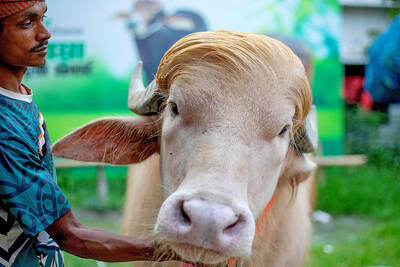
Crowds in Bangladesh are flocking to snap photographs with an unlikely social media star — an albino buffalo with flowing blond hair nicknamed “Donald Trump” that is due to be sacrificed within days. Owner Zia Uddin Mridha, 38, said his brother named the 700kg bull over its flowing helmet of hair resembling the signature look of the US president. “My younger brother picked this name because of the buffalo’s extraordinary hair,” he said at his farm in Narayanganj, just outside the capital, Dhaka. Mridha said that a constant stream of curious visitors — social media fans, onlookers and children — have come throughout

It began as a satirical online project. Now millions of young people in India are flocking to it as an outlet for their frustration. A parody political party called the Cockroach Janta Party, with the insect as its symbol, has exploded across India’s social media by turning absurdist humor into protest. Memes and short videos mocking corruption, joblessness and political dysfunction have flooded social media sites, where millions of users are embracing the cockroach — known for its ability to survive harsh conditions — as a tongue-in-cheek symbol of endurance. The online movement’s rise has been unusually rapid. The Cockroach Janta Party (CJP)
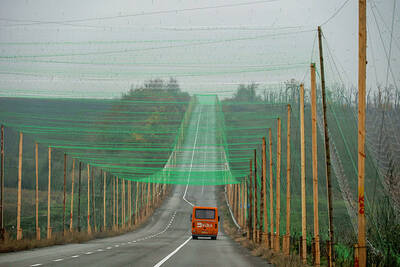
BIGGER ROLE: Beijing has said it maintains an impartial stance on the war in Ukraine, but by training Russian troops, China is far more involved than previously known China’s armed forces secretly trained about 200 Russian military personnel in China late last year, and some have since returned to fight in Ukraine, according to three European intelligence agencies and documents seen by Reuters. While China and Russia have held a number of joint military exercises since Moscow’s full-scale invasion of Ukraine in 2022, Beijing has repeatedly said that it is neutral in the conflict and presents itself as a peace mediator. The covert training sessions, which predominantly focused on the use of drones, were outlined in a dual-language Russian-Chinese agreement signed by senior Russian and Chinese officers in Beijing on
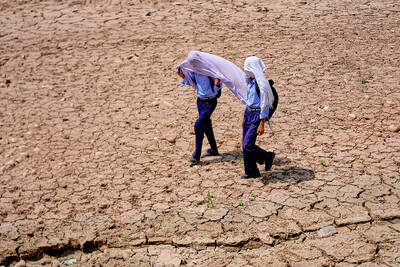
HOTTER: While Indians are accustomed to summer heat, climate change has caused northwestern India to warm faster than other parts of the country, an academic said Roads and markets have emptied during afternoons and some farmers have switched to nighttime work to avoid scorching temperatures as a heat wave grips large parts of India. The India Meteorological Department forecast maximum temperatures for yesterday of about 45°C in the capital, New Delhi, where authorities have opened temporary “cooling zones” to help people cope. The weather department warned that conditions would likely persist across several northern regions in the coming days, with temperatures staying well above seasonal averages. Authorities urged people to stay indoors during the hottest hours and take precautions against heat-related illnesses. India declares a heat wave whenever maximum temperatures


 RSS
RSS